|
|
|
Welcome to the latest edition of my e-newsletter!
Below, you’ll find an update on what’s happening in your state Capitol and some additional resources I hope you find helpful. For additional updates on what’s happening in Lansing or the state Legislature, please feel free to contact my office or visit my X and Facebook pages.
Thank you for allowing me to represent you in the Michigan Senate. I am grateful each and every day to work for the people of the 22nd Senate District.
Sincerely,
Lana Theis
State Senator
22nd Senate District
|
|
|
|
|
|
|
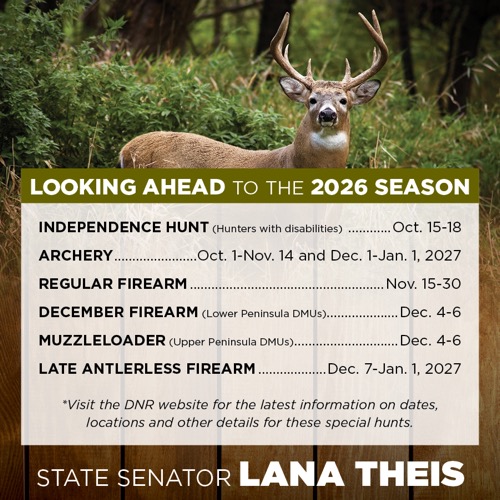
Michigan’s deer hunting season is well underway. Here are a few important reminders:
|
|
|
|
|
|
|
| ▪ |
Many changes have been made ahead of the 2026 season, including hunt dates and license-use limits. Be sure to review and download the Deer Hunting Regulation Summary before heading into the field. You can also contact my office for a free hard copy. |
| ▪ |
The DNR has launched a new version of MiHunt, an interactive map of lands open for public hunting. |
| ▪ |
• A successful harvest must be reported within 72 hours. Reports can be made online or through the DNR app. |
|
|
|
|
|
|
|
First confirmed cases of EHD in 2026
|
|
|
|
|
|
|
The Michigan Department of Natural Resources has confirmed the state’s first 2026 cases of epizootic hemorrhagic disease (EHD) in free-ranging white-tailed deer, with cases now confirmed in 12 counties, including Allegan, Branch, Hillsdale, Ingham, Jackson, Lapeer, Lenawee, Montcalm, Oakland, Oceana, Saginaw and Washtenaw. As samples are submitted from other counties, any new cases will be posted on the DNR’s EHD website.
EHD is a virus that affects white-tailed deer and can make them very sick and sometimes be fatal. Deer are infected through a midge or biting fly. EHD is not spread from deer to deer and can only be confirmed through lab testing.
Sick and dead deer are often found in or around bodies of water. A sick deer may appear weak, confused, lame or unresponsive. Other signs may include a bloody nose or mouth, a swollen or blue tongue, or swelling around the eyes, head or neck.
If you suspect you have found a deer that has contracted or died from EHD, please submit a diseased wildlife report through the DNR’s Eyes in the Field system.
|
|
|
|
|
|
New online tool for youth employment permits
|
|
|
|
|
|
|
Michigan is launching a new Youth Employment Permit Portal (YEPP) to make it easier for students and employers to complete the work permit process online.
Until now, local school districts and nonpublic schools have been responsible for issuing youth employment permits for workers under 18. Beginning in early October, the process will move to YEPP, a centralized online portal that will make permits more convenient for employers and young workers to access.
Click here for more information about YEPP, including a prerecorded webinar.
|
|
|
|
|
|
Tuition-free community college
|
|
|
|
|
|
|
Michigan now offers students and adults opportunities to attend community college, complete job training or earn a skills certificate tuition-free. These programs can help reduce education costs and provide a path to new career opportunities.
The Community College Guarantee offers recent high school graduates a tuition-free path to attend their local community college, earn an associate degree or make progress toward a bachelor’s degree. For adults 21 or older who do not already have a college degree, Michigan Reconnect can help cover job training or up to two years at a local community college tuition-free.
|
|
|
|
|
|
Invasive species grant funding available
|
|
|
|
|
|
|
The Michigan Invasive Species Grant Program is accepting proposals for the 2026 funding cycle. The program is a joint effort by the departments of Natural Resources; Environment, Great Lakes, and Energy; and Agriculture and Rural Development to prevent, detect and control invasive species across the state.
Grants are available to local, state, federal and tribal units of government, as well as nonprofits and universities. Since 2014, the program has awarded more than $42 million to 328 projects, helping manage invasive species such as hemlock woolly adelgid and European frog-bit. In total, more than 720,000 acres of land and water have been surveyed, and approximately 60,000 acres have been treated for invasive species. An estimated $2.4 million will be available for the 2026 grant cycle.
Highlights of the 2025 invasive species program are available in the Michigan Invasive Species Program Annual Report.
The 2026 grant program handbook outlines program priorities and application guidelines. Applicants are encouraged to watch the grant information webinar to learn more about program priorities and the application process. Full proposals are due Nov. 1.
|
|
|
|
|
|
|
Beginning Jan. 1, 2027, Michigan will ban out-of-state, untreated firewood to help protect the state’s agriculture, forests and natural resources.
Firewood is one of the most common ways invasive pests and diseases are spread to new areas. The firewood quarantine will help protect Michigan’s farms, forests, communities and industries from the damage invasive species can cause. Other Great Lakes states, including Minnesota and Wisconsin, have similar programs.
The firewood quarantine will NOT apply to:
|
|
|
|
|
|
|
| ▪ |
Certified, heat-treated firewood that is properly labeled. |
| ▪ |
Kiln-dried dimensional lumber. |
| ▪ |
Wood chips measuring no more than 1 inch in two dimensions. |
| ▪ |
Certain raw wood products that are transported directly to facilities for immediate processing. |
|
|
|
|
|
|
|
Preparing your family for emergencies
|
|
|
|
|
|
|
Emergencies such as power outages, fires and tornadoes can happen at any time. It’s important for families to have a plan to stay connected and communicate during a crisis.
Technology has made it easier to stay in touch, but it can be unreliable during an emergency if you’re not prepared. To prepare:
|
|
|
|
|
|
|
| ▪ |
Keep your family’s contact information written down in your purse or wallet. |
| ▪ |
Keep important documents safe by saving them on a USB drive that requires a password or in a secure online account. |
| ▪ |
Have an emergency charging option for your phone and other mobile devices. |
| ▪ |
Establish alternative methods of communication in case traditional methods are unavailable. |
|
|
|
|
|
|
|
Plan your next Michigan adventure
|
|
|
|
|
|
|
My office offers a series of free publications that highlight the many exciting outdoor opportunities Michigan has to offer. From Michigan history to exciting day trips with the family, I hope you find these resources helpful in planning your next Pure Michigan adventure.
My office has hard copies of the 2026 Fall/Winter Travel Guide for those who are looking for ideas for their next fall adventure. Feel free to contact my office at 517-373-2420 or SenLTheis@Senate.Michigan.gov for a free hard copy.
My office can also provide hard copies of the other publications listed on my website under the “Publications” tab.
|
|
|
|
|
|
Know your class, ride responsibly: E-bikes on Michigan DNR-managed lands
|
|
|
|
|
|
|
Michigan is home to countless miles of trails and endless opportunities to experience our unique natural resources.
Electric bicycles, or e-bikes, are growing in popularity, and Michiganders of all ages are taking up the hobby. While e-bikes are permitted in some outdoor areas, it is important to recognize the distinctions between classes and where these vehicles can be ridden.
Michigan defines three legal e-bike classes. On DNR-managed trails, Class 1 has the broadest access; Class 2 access generally requires a DNR-issued mobility permit; and Class 3 e-bikes are not allowed on state-managed trails.
Trail access by e-bike class:
|
|
|
|
|
|
|
| ▪ |
Class 1: Pedal-assist only; motor assistance ends at 20 mph. Class 1 e-bikes are allowed in the state park, recreation area and state forest trails or pathways that permit traditional bicycles, except for the locations listed below. |
| ▪ |
Class 2: Throttle- and pedal-assisted; motor propulsion ends at 20 mph. Class 2 e-bikes are allowed where Class 1 e-bikes are permitted for a person with a mobility disability affecting one or more lower extremities, after DNR verification of credible assurance and issuance of an annual use permit. |
| ▪ |
Class 3: Pedal-assist only; motor assistance ends at 28 mph. Class 3 e-bikes are not allowed on any state-managed trail. They may be ridden on DNR-managed roads wherever a non-electric bicycle may be ridden. |
|
|
|
|
|
|
|
|
Important Class 1 restrictions:
|
|
|
|
|
|
|
| ▪ |
State game and wildlife areas: E-bikes are not permitted on trails or pathways. |
| ▪ |
Congressionally authorized trails: E-bikes are not permitted on DNR-managed portions, including the North Country National Scenic Trail. |
| ▪ |
Pigeon River Country State Forest: Class 1 e-bikes are prohibited on the High Country, Shingle Mill and Pickerel Lake pathways. |
|
|
|
|
|
|
|
|
Remember: Ride smart, ride kind. Before you head out, be sure to check the specific trail’s posted rules and current conditions. Keep your speed appropriate for traffic, terrain and weather; yield to hikers and horses; and protect the trail by avoiding wet or damaged surfaces.
Click here for current rules, permit details and trail information.
|
|
|
|
|
|
|
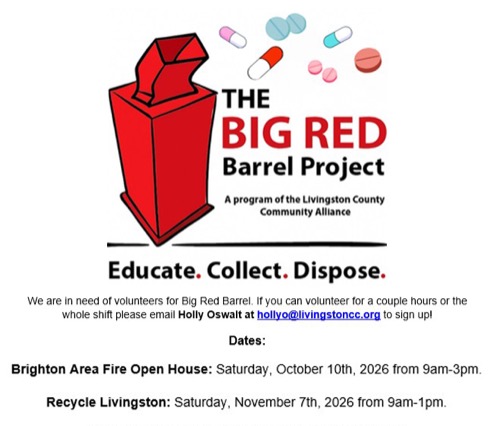
Addiction typically starts with prescription medication abuse, specifically heavy painkillers.
After numerous deaths throughout Livingston County that were attributed to drug overdoses, Livingston County Community Alliance (LCCA) members saw the need for a place where people could safely dispose of their unwanted medication. The Big Red Barrel Project has resulted in the secure and environmentally safe disposal of over 50 tons (or 100,000 pounds) of drugs.
With permanent prescription drug collection units available for community use, it would decrease the likelihood of prescription drug abuse and heroin use and maintain a healthy environment.
Click here to learn more about the Big Red Barrel Project and disposal dates for the remainder of the year. You can also view the Big Red Barrel Project’s Facebook page for additional information
|
|
|
|
|
|
|
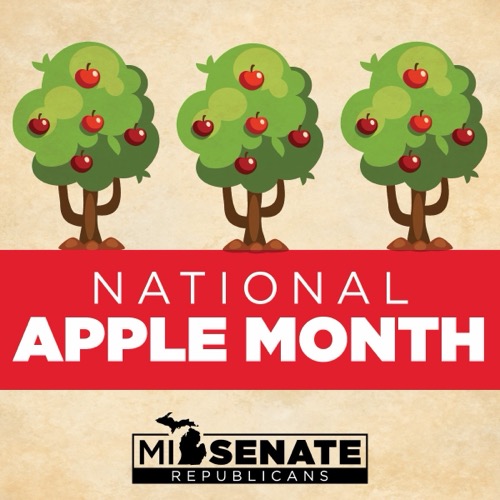
Apples are Michigan’s largest and most valuable fruit crop, led by 850 multigenerational family farms. This year, the apple crop is expected to be above average and produce more than 25 million bushels.
October is National Apple Month, a good time to visit a farm or cider mill and look for Michigan apples at your local grocery store.
|
|
|
|
|
|
Stay connected to important community resources
|
|
|
|
|
|
|
Weather conditions
For the latest weather forecasts, watches, warnings, and emergency alerts, visit the National Weather Service at weather.gov or monitor local news and emergency management updates. Residents can also receive emergency alerts directly on their mobile devices through Wireless Emergency Alerts and local notification systems.
Check road conditions before you travel
Before heading out, visit MDOT's MiDrive website for real-time traffic information, construction updates, lane closures, crash reports, and roadway camera views. The site provides up-to-date information to help motorists plan safe and efficient travel across Michigan.
Need help? Call 2-1-1
Michigan residents can dial 2-1-1 or visit mi211.org to connect with local resources and assistance programs.
Trained specialists can help residents find services such as warming and cooling centers, food assistance, housing support, utility assistance, transportation resources, and other community services available in their area.
This information is provided as a public service to help residents stay safe, informed, and connected to available resources throughout the year.
|
|
|
|
|
|
|
Thank you for subscribing to my electronic newsletter! As always, please do not hesitate to contact me if you have any questions or concerns. Please feel free to forward this on to others who may be interested in receiving the 22nd District E-news. You may sign up for it also at my website.
|
|
|
|
|
|
| |
Senator Lana Theis
Connie B. Binsfeld Office Building, Suite #7400
P.O. Box 30036
Lansing, MI 48909-7536
|
| |
|
|
|
|
|