|
|
|
Dear Friends,
Welcome to the latest edition of my monthly e-newsletter. As always, I hope you find the news and information below helpful. Please feel free to share this newsletter with anyone who may be interested.
My staff and I are available should you have any thoughts or concerns about state government. Please feel free to contact my office at SenKDaley@senate.michigan.gov or 517-373-1777.
Sincerely,
|
|
|
|
|
|
|
Kevin Daley
State Senator
26th District
|
|
|
|
|
|
Daley bill to increase organ donor registrations signed by governor
|
|
|
|
|
|
|
Although my son Thomas passed away over 15 years ago, he lives on in the lives of others due to the gift of organ donation. Since then, I have been passionate about encouraging lifesaving and life-changing organ donations. This new law can help other families who face the tragic death of a loved one with the comfort of knowing the gift of donated organs and tissues can give others and their families the gift of life.
Senate Bill 205, now Public Act 50 of 2026, allows physicians to inquire about patients’ interest in becoming a bone marrow donor or organ and tissue donor and subsequently provide information about how to register.
This reform will provide another way for people to have a conversation about becoming a lifesaving organ donor. We previously enacted legislation giving folks an opportunity to register as an organ donor when they get or renew a driver’s license or state ID card at a Secretary of State branch office. But with more people renewing these items online, there are fewer face-to-face discussions about the state’s organ donor registry.
Gift of Life Michigan reports that 131 lives are saved each day by organ transplants throughout the United States. More than 9,000 patients in Michigan have received a lifesaving organ transplant in the past 10 years.
Visit Michigan.gov/SOS/All-Services/Organ-Donor-Registry to learn more or register as an organ donor.
|
|
|
|
|
|
|
The Michigan Department of Health and Human Services continues to investigate the cyclosporiasis outbreak in Michigan. The state typically identifies 50 cases a year. This year, more than 11,000 cases have been reported.
Previous outbreaks in the U.S. and Canada have been linked to bagged salad mixes and kits, fresh cilantro, basil, raspberries, snow peas and green onions. Although the exact source of this outbreak has not been identified, MDHHS recommends the following lettuce safety tips:
|
|
|
|
|
|
Guardianship reforms signed into law
|
|
|
|
|
|
|
New laws to reform Michigan’s guardianship system and better protect vulnerable individuals and their homes have been signed into law.
Public Act 69 requires court approval before a guardian can change an incapacitated person’s residence after demonstrating to the court that the move is necessary and appropriate for the individual’s needs. Public Act 68 requires a licensed appraisal before a protected person’s home may be sold.
The new reforms strengthen oversight and accountability in Michigan’s guardianship system.
|
|
|
|
|
|
2026 primary election is over
|
|
|
|
|
|
Stronger protections for missing children become law
|
|
|
|
|
|
|
New laws expanding protections for missing children in Michigan have been signed into law.
Public Acts 55 and 56 expand Michigan’s child alert system by allowing public broadcasts for missing children who are not believed to have been abducted. The laws also authorize the use of social media to distribute information and alert the public about missing children.
In addition, the laws require the Michigan State Police to issue an Amber Alert for a missing child with special needs or any missing child determined to be in danger following a preliminary investigation.
The changes expand Michigan’s child alert system and address gaps in the Amber Alert process.
|
|
|
|
|
|
New laws allow paid military leave
|
|
|
|
|
|
|
New laws have been signed to better support firefighters and police officers who also serve in the National Guard or reserves.
Public Acts 57 and 58 ensure eligible first responders receive at least 26 days of paid military leave each year, allowing them to fulfill military training and deployment obligations without using vacation time or taking unpaid leave.
The new acts help ensure first responders can meet their military obligations without losing income.
|
|
|
|
|
|
E-biking on Michigan’s roads and trails
|
|
|
|
|
|
|
An e-bike is a bicycle equipped with a rechargeable electric motor that assists while pedaling or can power the bike on its own. Some e-bikes may be used on DNR-managed trails and other paths within state parks and recreation areas.
Michigan classifies e-bikes into three categories that determine where they can be ridden:
|
|
|
|
|
|
|
| ▪ |
Class 1: Pedal-assisted up to 20 mph. Allowed on DNR-managed trails where traditional bikes are permitted, except in state game and wildlife areas, the North Country Trail, High Country, Shingle Mill and Pickerel Lake pathways in Pigeon River Country. |
| ▪ |
Class 2: Throttle- and pedal-assisted up to 20 mph. Allowed only for mobility use with a free DNR-issued permit on DNR-managed trails. |
| ▪ |
Class 3: Pedal-assisted up to 28 mph. Not permitted on state-managed trails. |
|
|
|
|
|
|
|
|
E-motos, such as electric mopeds, motorcycles and dirt bikes, are not considered e-bikes and are not allowed on DNR-managed trails.
|
|
|
|
|
|
Digital kill tags available for deer season
|
|
|
|
|
|
|
The Department of Natural Resources is offering eHarvest as an optional digital tagging system for deer hunters this fall. Hunters may use the Michigan DNR Hunt Fish app to electronically tag harvested deer instead of using a paper kill tag. Hunters may continue using paper tags if they prefer.
The system allows hunters to validate their harvest directly after the animal is taken and works without a cellular connection. Once validated, the tag is recorded and time-stamped on the hunter’s device.
|
|
|
|
|
|
Celebrating Michigan’s cherry industry
|
|
|
|
|
|
|
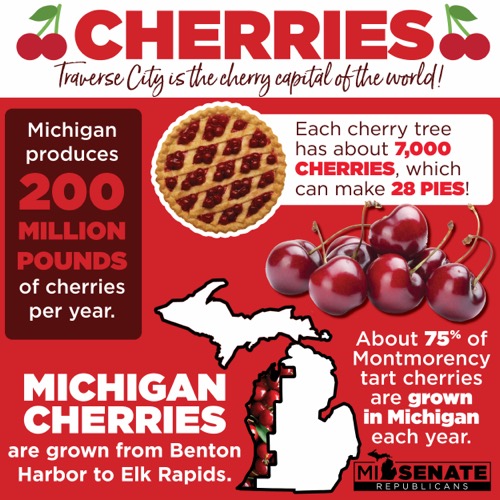
Michigan is the nation’s leading producer of tart cherries, growing about 75% of the U.S. supply. Cherry orchards stretch along Lake Michigan from Benton Harbor to Elk Rapids.
Michigan’s first commercial tart cherry orchards were planted in 1893. By the early 1900s, the industry was firmly established. Today, cherry production contributes tens of millions of dollars annually to the state’s economy.
|
|
|
|
|
|
|
| ▪ |
Buy whole heads of lettuce instead of prewashed, bagged lettuce or salad kits. |
| ▪ |
Discard the outer two or three layers of leaves before preparing the lettuce. |
| ▪ |
Wash the remaining inner leaves thoroughly under clean running water. |
| ▪ |
Cook greens when possible. The parasite is resistant to routine chemical disinfection, and washing alone can’t guarantee its removal. Cooking to an internal temperature of at least 158 F (70 C) is the safest option. |
|
|
|
|
|
|
|
|
To reduce the risk when eating other fruits and vegetables, cook the produce when possible. For produce with removable skin, wash it under clean running water before peeling. Prewashed lettuce is not guaranteed to be safe, and rewashing bagged lettuce is unlikely to remove the parasite.
Click here for the latest information on the cyclosporiasis outbreak in Michigan.
|
|
|
|
|
|
Celebrating a special occasion?
|
|
|
|
|
|
|
My office is happy to offer legislative tributes in honor of noteworthy events such as retirement, anniversaries of businesses in our community, awards and public recognitions.
|
|
|
|
|
|